
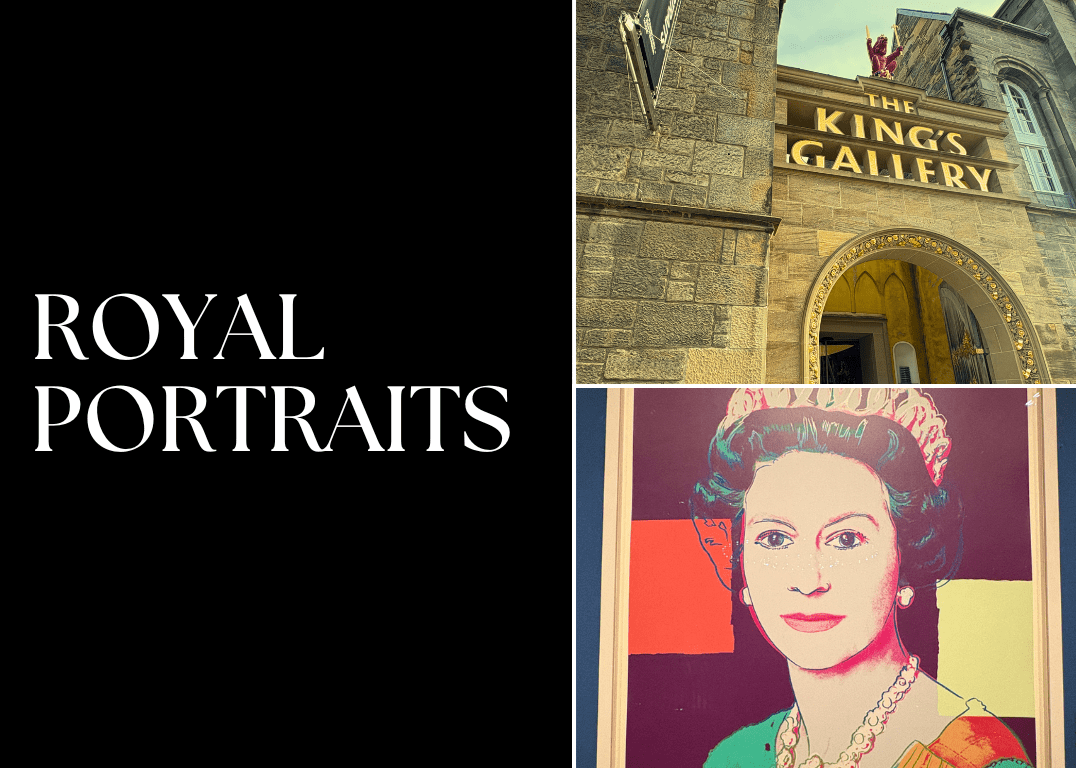
Late and amusingly disheveled, we entered The King’s Gallery on a breathy, chilly late February morning in Edinburgh for the Royal Portraits: A Century of Photography exhibit.
‘Sorry, we currently have a private event in session,’ a polite member of staff said. ‘That’s exactly what we’re here for,’ we replied, looking like the wind had unforgivingly swept us through the door by complete accident.
We arrived in front of the exhibit’s curator, Alessandro Nasini, and joined a small crowd of press. There was a sort of quaint, coffee shop ambience to this royal gallery – a combination of low lighting and warm wood.
It felt like we were a group of close confidants to Nasini as he carefully divulged the history behind the images of a family we couldn’t be further removed from.
From one end of the room to the other, regal eyes peered upon us, some familiar and others that said ‘we should be familiar’.
And as we moved along the walls, one photograph said more than the rest. I knew it from the hit Netflix series, The Crown. Gazing over a bare shoulder was Princess Margaret, the sister of Queen Elizabeth II. How scandalous.
Photography and intimacy
Photographs are timeless confessions, I thought as I felt the visceral chemistry between subject and photographer. To see this image was to feel like an invasive reader of someone’s diary.
Or was this vulnerability, a symptom of truth, of authenticity, that felt strange to bear witness to? Strange because this is something that we don’t often associate with a family so concerned with displays of power.
The photographer, Lord Snowdon (Antony Armstrong-Jones), and Princess Margaret had a rather famously complex relationship.
It was the first time a commoner had married a King’s daughter in over 400 years, making their connection a radical act in the face of such tradition.
It was a relationship fraught with affairs, romantic passion and public scrutiny. In this one small moment, it was captured forever.
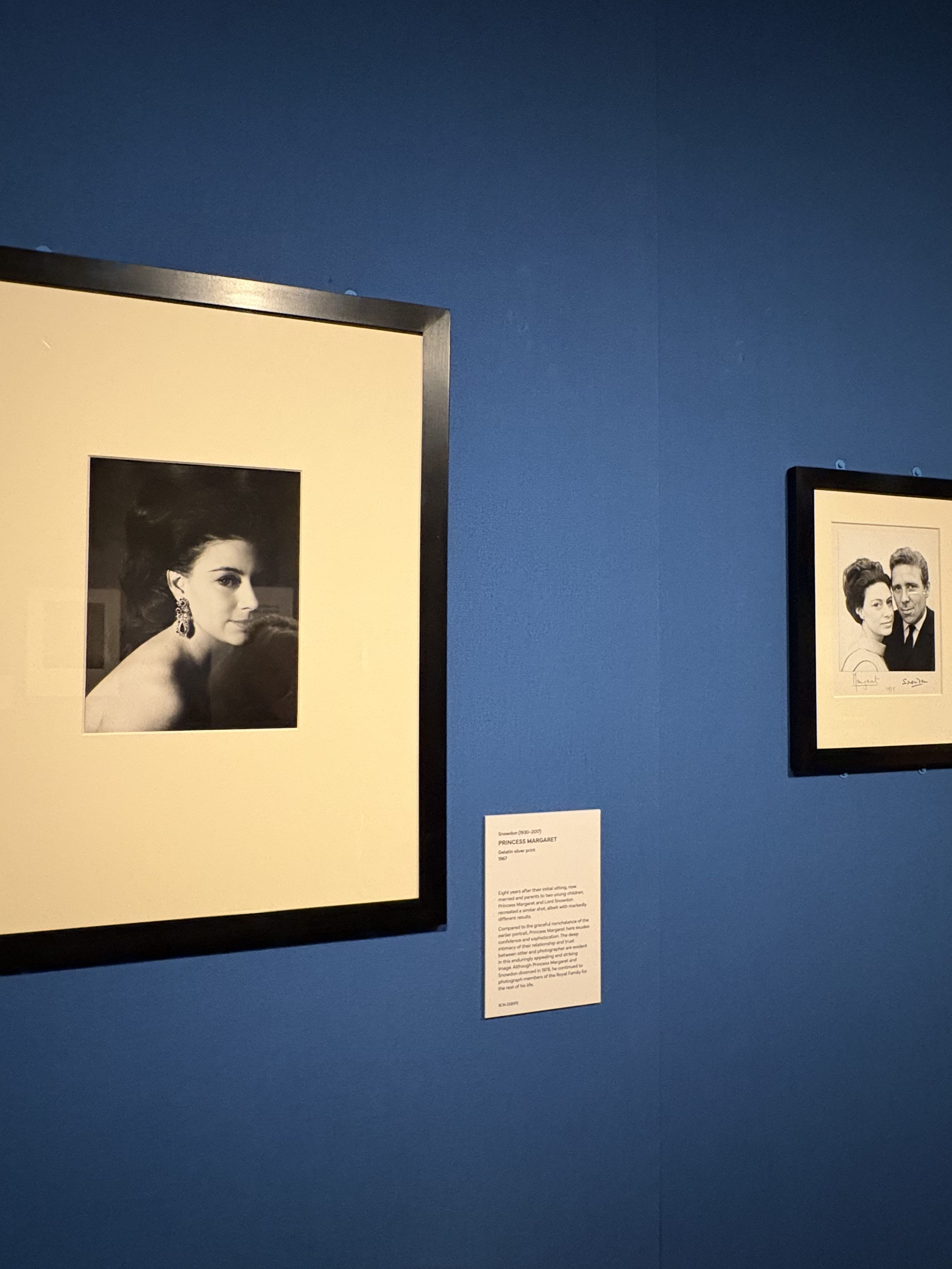
What made Snowdon such an unconventional and groundbreaking photographer was his use of close cropping. There Margaret was, framed tightly between light and dark, shoulders exposed, not just to Snowdon, but to the world.
Royal photography had always remained a level of distance and professionalism and this photograph was the very antithesis. And that’s exactly why I loved it.
Her knowing gaze, her cinematic glamour associated with the likes of Marilyn Monroe or Bette Davis, felt like a challenge to tradition.
And love, really passionate love, often manifests itself as that. Princess Margaret appeared strikingly as more of a film star than royal.
It goes without saying that Snowdon’s photographs of Margaret were reflections of their relationship. His photographs were not how the royals wanted to be perceived, but exactly how Snowdon perceived her. Not as a reigning figure of ultimate power, but as a lover.
Margaret, for the first time in the public’s eyes, was not seen as an untouchable figure but an individual with a backstory. One filled with rampant emotions – like us all. That’s what makes it feel so real.
The power of illusion & the illusion of power
As Nasini gently moved us from wall to wall, a whimsically ominous photograph from Annie Leibovitz of Queen Elizabeth II hangs contrastingly against the vibrant blue walls of the gallery. My partner nudges me with the back of his hand, taken by the presence.
This was the epitome of power. A cape-adorned Queen Elizabeth II, silver and precise, was pinned in front of a tree-cradled loch and thunderous grey skies that slightly vignetted around her.
If it weren’t for the subtle glows of gold details on her cape, the photograph would certainly appear villain-esque.
This picture held a great secrecy in contrast to Snowdon’s, almost as if The Queen were hiding something under that cape. There was a desire to be concealed and it showed.
However, in all its indisputable glory, there was something slightly off-putting with her appearance. She appeared vaguely cut off from her surroundings, like she wasn’t actually present at all.
My suspicions were confirmed when Nasini let us into a little secret: she’d been superimposed onto this eerie background, and I couldn’t see anything more beyond that from thereon.
It diminished its enchantment. The same sort of feeling when you learn that Santa isn’t real.
And the frustrating thing was, I simultaneously loved and hated the image. Its ability to grip me and have me in a strange commoner’s choke-hold of admirability for a moment. Yet, the longer I looked at it, the looser its grip. Time loves to tell the truth.
And the truth has a remarkable way of making a mockery out of perceived power. It wasn’t long before it left me feeling disillusioned and I’m not quite sure what that says about the power of photography. Did I enjoy being deceived? Or, does the truth set us free?
Unlike Snowdon’s raw intimacy, Leibovitz’s Queen is shrouded in theatricality. Perhaps power is, at its core, the art of illusion.
A different kind of truth
As the tour came to a close, we were invited to wander the corridors and enter into our own dialogue with the regal eyes. I headed straight for a diamond dusted masterpiece.
A poignant stamp of pop culture created by none other than Andy Warhol. As a Velvet Underground fan and Warhol enthusiast, this was my Queen.
In front of me was a 1985 reproduction of a Silver Jubilee image, transformed by Warhol to represent ‘an icon’ rather than ‘a royal’. Halycon Gallery says that Warhol captures the Queen’s ‘power’, but I’d have to disagree.
It had Warhol’s playful, childlike quality and in his interpretation, at least from my view, he did the opposite. He stripped her of her power – and I loved him all the more for it.
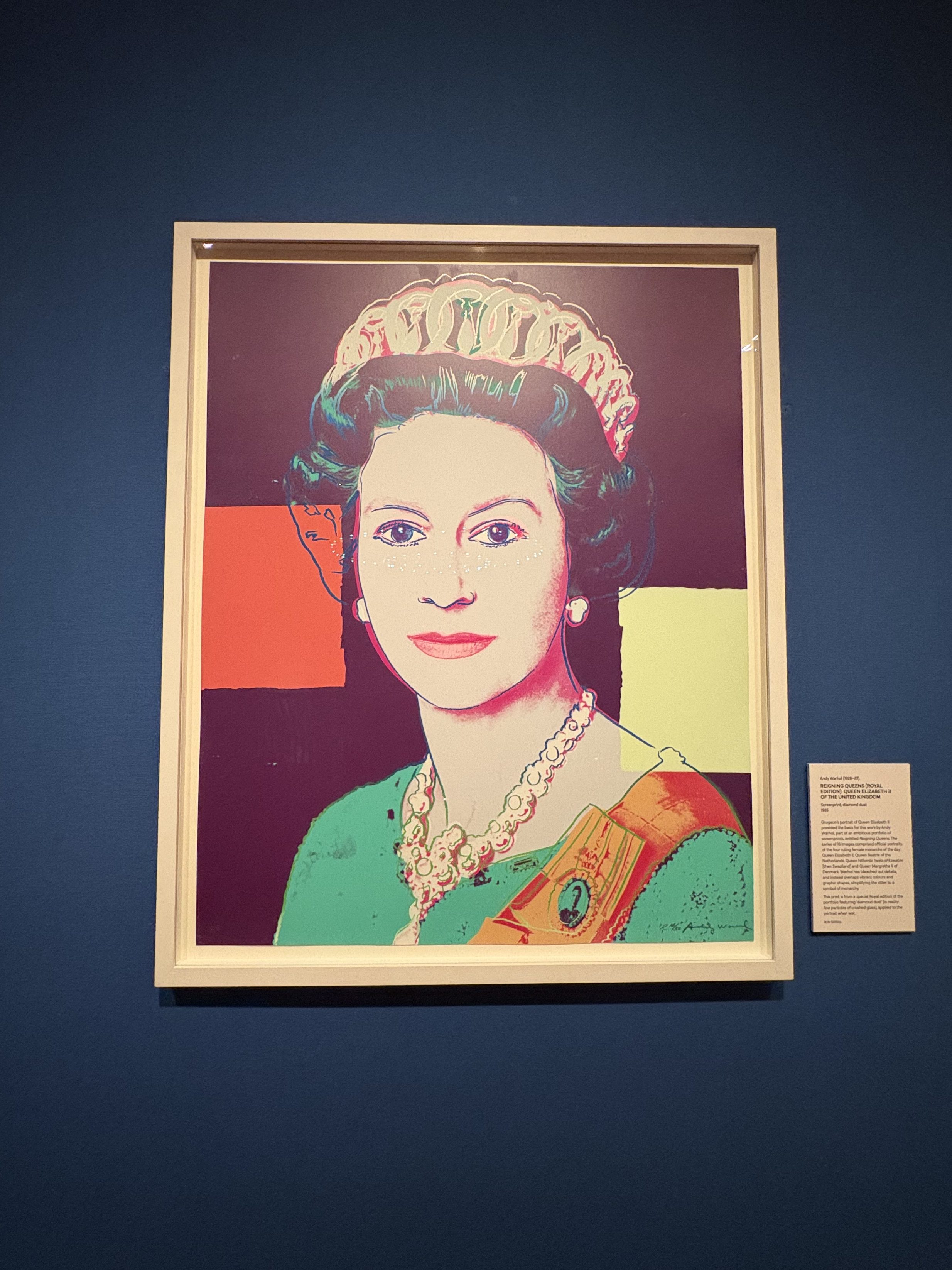
Warhol’s work, though surrealistic, is not a truth concealed but an intentionally distorted truth. A different kind of truth, if you will.
It doesn’t pretend to be something it’s not. He is unapologetically playing with reality and with this image, he is telling us that even the Royal’s aren’t untouchable when it comes to this. It’s an interpretation, not a deception.
Leibovitz’s displays a digitally manipulated grandeur, Warhol doesn’t try to maintain the illusion of reality—he bends it, shapes it, owns it.
And I think that’s what Snowdon and Warhol’s images have in common: they actually reveal more about themselves than anybody else.
Susan Sontag, author of On Photography (1977) says: “The painter constructs, the photographer discloses.”
Where Snowdon reveals a piece of evidence, a disclosure of something more intimate, Warhol constructs. He plays. And both of these are radical acts that challenge the perception of the royalty.
Truth and illusion
Philosophers, authors, politicians, scientists, your dentist and local shopkeeper have been arguing which truths are truer truths over coffee on French balconies for centuries. And they will for centuries to come.
So, perhaps it isn’t the power of illusion nor the illusion of power, but the power of perception.
In honesty, I didn’t leave The King’s Gallery feeling any different toward the Royals. No matter how many different power stances and close crops I came up against on my tour, I saw what I wanted to see: the truth.
Status, titles, money and decorations don’t maketh the person no matter how you try to paint it.
Discover more from
Subscribe to get the latest posts sent to your email.

