
With TikTok now becoming people’s lockdown boredom eradicator and favourite pastime over the last year, Instagram has still managed to hold its own as a social media melting pot with roughly one billion users. It’s stood proud, tall and unmoved like a vast, ancient oak tree filled with little branches and diversions off into the eccentric, weird and wonderful. From the fitness side of Instagram to the cleaning side, there seems to be a community within a social media district for everyone. What started off as a photo-sharing app has become a colossal billion-user hub for some money-making factions. Some are a little less known but a lot more fascinating: Meet the social media subculture that’s centred on living in the past.
Thousands of those users make up a little subculture on Instagram’s outskirts known as the ‘60s/70s community’ or ‘60s/70s revival’, using hashtags such as ‘60s’ and ‘70s’ to connect with other users exploring that mid-century neck of the woods. The ‘60s’ hashtag alone has 4.3 million user posts attributed to it.
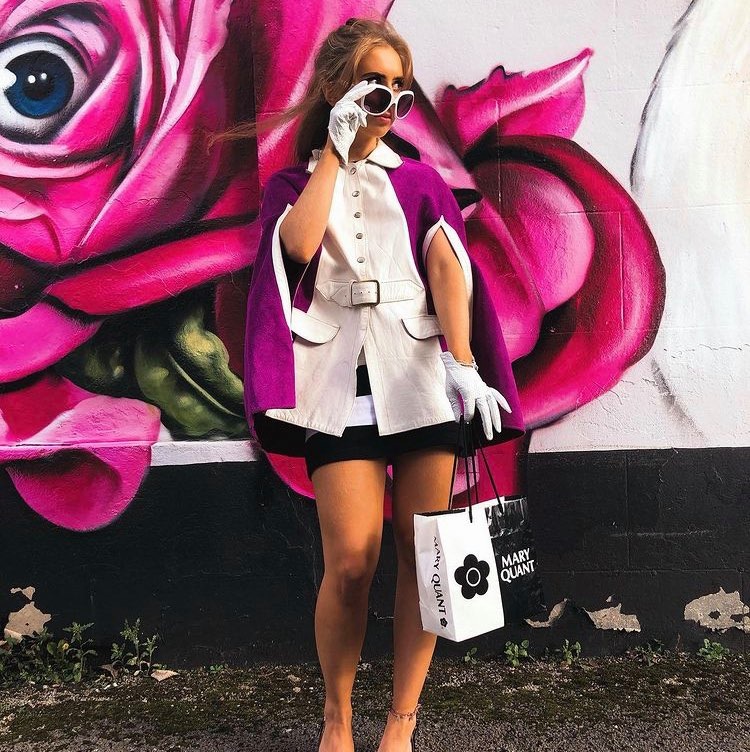
Suppose you were to explore these hashtags on Instagram. You’ll not only be shown pictures of Bowie, Sharon Tate and the Beatles, but you’ll also be blitzed with white go-go boots, vibrant colours and a real feeling that you’ve wandered into an old archive of unknown authentic models from the time, but be fooled not. These are active modern accounts that are entirely based on the retro and vintage aesthetic of years that, more than likely, their grandmother’s would have lived through.
So, already you may be thinking “how did a few decades from the past turn into a little subsection of the social media world?”. Well, this is a relatively new subculture of Instagram that has only formed within the last 6 years. Yet it is peaking now more than ever. Speaking to Alexandra Rose, a 21-year-old musician and Law student from the West Midlands, she reveals how she found her way into the community: “I have always been a lover and collector of 60s vintage fashion, music and memorabilia etc. and wanted to meet likeminded people out there who enjoyed the style and movement that I’m so heavily invested in.”
Alexandra then goes onto discuss the impact of a simple hashtag: “I saw others using the hashtag 60s and wanted to be part of their scene. I didn’t know how big it was until a month in I discovered so many accounts of likeminded people. People were very friendly, supportive and welcoming.”
Many community members admit that their own political compass aligns with that of the 60s and 70s thus it has become a massive part of why so many people have grown to love this space. It’s almost as if Instagram is a new, modern medium of political self-expression and liberal thinking, becoming a powerful tool intertwined within the relationship between music, fashion and politics. Alexandra goes on to explain this:
“I think the thing that’s so fascinating about the 60s was that it was a melting pot of new wave thinking. The whole movement developed not only because of innovators in music and fashion but also as a product of politics, women’s liberation, challenging class barriers, civil rights, lgbtq+ recognition, the pill, drugs etc.— every aspect and social norm changed in that time which is why I love its freshness so much. It’s all interlinked. It still has a long way to go, but the 60s marked the start of the revolution into liberal thinking.”
20-year-old German Romance Languages and Literature major and active participant in the community since 2015, Selina, agrees with this by saying:
“My political views are very leftist because there is so much injustice in the world—which I’m trying to change by protesting and helping out with election campaigns in my city. I really admire the hippie movement of the 60s and also the punk scene of the 70s so much because back then, the people weren’t as afraid of the consequences when they spoke their opinion on things that had to change.”
Just like in most tangible subcultures, this digital one has its very own icons. Users who are at the top of the social media hierarchy with thousands of followers. These are followers who become inspired by and mimic their content whilst communicating with others that do the same, thus creating a community. For this subculture, two of the biggest icons in the field are 24-year-old YouTube and Instagram star Devyn Crimson and 28-year-old fashion model Storm Calysta. Both of which are credited for their pioneering in the social media 60s/70s revival and known as the reason for why many people became so involved.
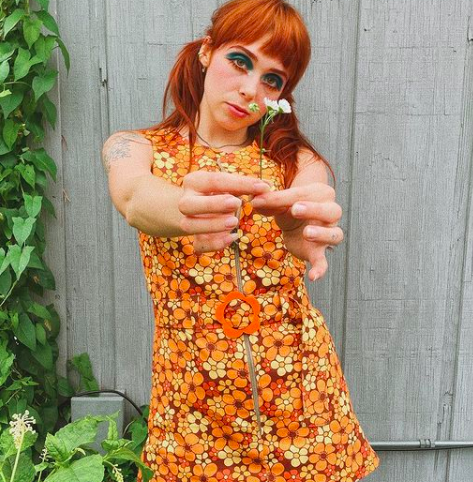
Alyssa, who is 18-years-old and a high school senior from Canada, expresses her reasons for joining the community: “I always wanted to be an ‘influencer’ in the community. I started as most people did by following Devyn Crimson and branching off from there.” Selina also states that Devyn was one of her main inspirations, and from watching her YouTube channel, she decided to dip her toes into the community.
Devyn Crimson, who has an impressive 77k followers on Instagram and an even more impressive 101k subscribers on Youtube, explains how there was an already ‘vintage scene’ on Instagram in 2012, however under established it was in comparison to now: “There was already definitely something there when I joined, meaning following other vintage inspired creatives and posting my own vintage inspired photos. I was a sophomore in high school.”
Another icon in the community and mother of two with over 11k followers, Leah Horrocks, 29, (@70smomma) shared a similar experience as one of the ‘OG’s’ like Devyn, stating: “I made my account back in 2012. I’m not sure when the ‘vintage community’ started but I was in it from the very start. I’m one of the originals here.”
Devyn and Leah’s experiences are also similar in discovering and distinguishing their taste in music and fashion and how this developed online, sharing their love for creativity, colours and of course, bell bottoms.
Devyn reveals in our interview of when she began to notice her platform taking off: “Even at just 1k followers or so, which came kind of early for me for being a kid in small town Wisconsin, I was taken aback at the idea of anyone being interested in my life,” she continues, “…I really noticed it had the potential to be more than a hobby at least was when I was 19, working a job I hated for very little money. I really tried to put more energy into online stuff to see where it would take me.”
“I loved talking to people online, sharing life and creating art for others. I just want to be happy I have always said. Whatever I am doing, I just want to be happy doing it.”
Texas-based model, Storm Calysta who has almost a 55k following on Instagram, was happy to comment on both the growth of her audience and the growth of the community in general:
“I noticed a big jump in my audience growth during 2015 when I started doing modelling gigs and began sharing those photos to my Instagram. At the time, Instagram was still primarily a place to post cats and food pictures; very few people were doing the 60s/70s style revival at the time. People were intrigued when they stumbled upon my profile, thus resulting in my audience growing about 10k in a month.”
However, both Storm and others within the community claim that since the subculture’s growth, it has become infiltrated with lack of inclusion and over-saturation to the point that the roots on which the subculture has grown off of have been forgotten: “A big part of me misses it being more of a smaller niche because I feel like it’s a little oversaturated right now to the point where the history of the music, style and culture is being misconstrued from it’s highly important origins.”
High school senior Alyssa is actually no longer a part of the community as of 2020 due to what she reports is because of a multitude of reasons but mainly racism and elitism: “The teenage mod group really made/makes me uncomfortable. Excluding minorities from the conversation and having this snootiness and arrogance about them. I won’t name names, but when I check up on them, they’re the same. You’re 16 and have 10k on Instagram; you’re not Beyoncé. Plus, whenever they got called out on fatphobia, they were really fake and defensive, which didn’t sit right.”
This is to be expected in a community that has surged so quickly in such a short number of years. The larger a community, the more differences in opinion and before you know it, the foundations of the community have been buried under the ashes of hostile outside infiltration. This is why Alexandra Rose says that she prefers to not have idols within this subculture as, like many, she may run the risk of feeling inadequate if she too harshly compares herself to others.
The negative sides to social media are endless and have been widely debated for as long as it has existed. It’s important to remember that it’s not exclusive to just one sector either. A certain debate that keeps reappearing in modern culture is how social media acts as an escapism from reality, but what if that is mixed with a completely different decade? Is this an even further escape from reality…and is this a bad thing?
Leah Horrocks (@70smomma) spoke on whether she believes that the 60s/70s to some people is merely just a nice Instagram aesthetic or it’s truly a form of escapism from reality: “I think both. You never know if someone’s Instagram page is a true reflection of how someone actually lives their life, but I think a lot of times it is. Even if they are scared to dress vintage in the “real world”, Instagram gives them that space to show off how they really want to look/dress. A place to show off creativity.”
In our interview, Leah also spoke of how she can be negatively perceived by others as a big name within the community: “I’m sure you have seen I’m pretty controversial on here. Some people love me and others hate me, but it’s all good. I share about real topics that others tend to shy away from because it’s not the norm. I’m one of THE only ones in the community sharing the stuff I do and I’m okay with that.”
Speaking of the controversy surrounding her personal choices relating to covid vaccines, Leah continues: “I’ve been called some crazy things on here…conspiracy theorist, anti-vaxxer, dangerous, selfish. I know that I’m not any of those things but those are labels they like to give because they don’t get it. I keep fighting my fight and the ones who want to stick around, totally can. I’m so super grateful for my followers/anyone who supports me.”
Devyn spoke of her own experience within the social media subculture stating that: “The online space has been a very welcoming and kind place for me. Naturally, in any large group of people you’ll find someone who has a strange distaste for you, but that’s just life isn’t it? Only recently has anyone ever really tried to hurt me (not physically, though I did have a stalker early on).”
She elaborates by saying: “As the community grows, I am happy to see more representation of the diverse people that make up this community because really anyone who has a love for vintage is in the community as far as I’m concerned and that stretches to all walks of life. It’s beautiful to see it all come together.”
Finally, Devyn expresses how much the community has had on her life: “I really don’t know where I would be, what I would be doing if I hadn’t found this place. I found my career path through the community, my friends, my band. It really fuelled my love for the 60s & 70s knowing I wasn’t alone in my interests. So who knows if I would have even met my fiancé, moved to Chicago, gotten any modelling opportunities. I could never say ‘thank you’ enough to truly express my gratitude.”
The benefits of becoming so involved in an ever-growing subculture for those at the top are the modelling gigs, the brand sponsors and making an income from a hobby that inspires others. However, there is likely to be a few rotten apples in such a large community whereby the community’s soul and purpose become lost for those who follow, especially on Instagram. The core becomes lost under the surmounting pressures of how many followers they have and why they don’t look like their idols. Selina talks about the importance of holding true to the liberal values on which the community was built: “I think the spirit of the time is what makes people drawn to these decades. Back then, children were just children and didn’t focus on growing up fast or wanting to be popular.” Maybe it’s high time the 60s/70s subculture come together to centre on its own past roots and the ideals it was founded upon rather than getting caught up in the infiltration of the social media platforms’ popularity and monetary success. To avoid hypocrisy and sad irony, there needs to be a closer look at the decades before and the reasons why it became such a vast digital hub full of like-minded people for a more inclusive and progressive future.
Discover more from
Subscribe to get the latest posts sent to your email.
 ailsagillies.com